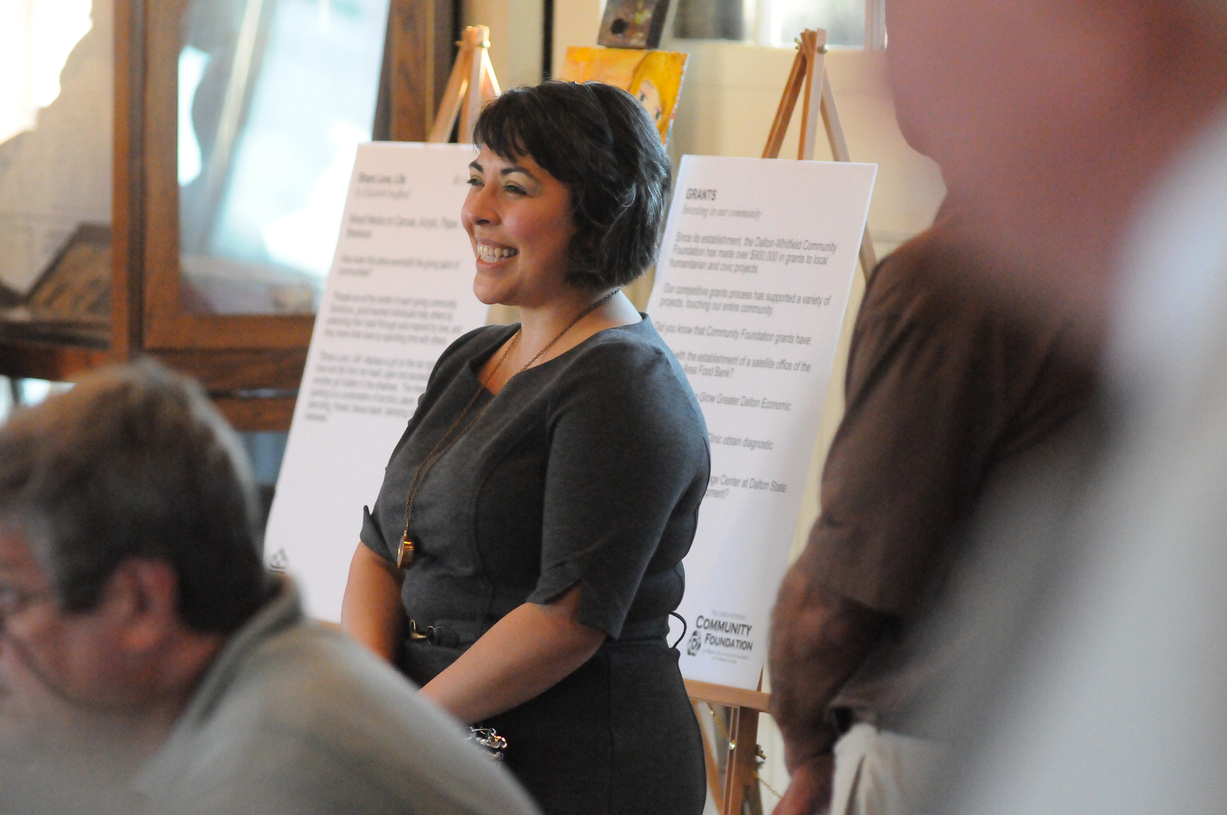
Elizabeth Swafford Earns ATEEG Distinction

 Elizabeth Swafford has been certified as an Environmental
Educator thru the nationally accredited professional development program
Advanced Training for Environmental Education in Georgia.


  0
  0
  1
  28
  163
  DWSWA
  1
  1
  190
  14.…


Elizabeth Swafford has been certified as an Environmental Educator thru the nationally accredited professional development program Advanced Training for Environmental Education in Georgia.

(Dalton, GA, October 27, 2013) –  Elizabeth Swafford, Recycling and Education Program Coordinator for the Dalton-Whitfield Solid Waste Authority, and Executive Director of Keep Dalton-Whitfield Beautiful, has earned the distinction of Certified Environmental Educator.  After completing a rigorous two and a half year study she received one of the first certifications for ATEEG, Advanced Training for Environmental Education in Georgia.  This professional certification program is offered by the University of Georgia’s Warnell School of Forestry and Natural Resources, and the Environmental Education Alliance of Georgia.

Swafford was recognized at the 2013 Environmental Education Alliance’s Annual Conference in March along with other educators who successfully completed the program, which is nationally accredited by the North American Association for Environmental Education.  The ATEEG certification required 30 hours of specialization workshops, completing three core courses, and an independent study project.  The courses focused on the foundations of environmental education, fostering learning, and assessment and evaluation.

This certification is of benefit to educators in the state who want to be recognized as a leader in the field of environmental education and gain credibility for the profession that is reflected in various career paths.  Educators can range from those in formal settings, such as a science teacher in a public school, to those working in non-formal educational settings like a nature center.  Swafford is a non-formal educator who teaches local students about recycling, the landfill, and other environmental topics through her work at the DWSWA and KDWB.

Swafford’s independent study project, Recycling Ben’s Sidekick Training, was designed to train third graders to become recycling superheroes.  During the special 4 hour program students made upcycled name tags, toured the landfill and recycling center in Whitfield County, made an edible model of a landfill, completed a recycling relay race, and met mascot Recycling Ben.  The project included all aspects of the ATEEG program, including components for assessment and evaluation. The special training is now part of the regular educational opportunities offered at the facility.

Open House for Educators at Recycling Center Announced

DALTON, GA – Local educators are invited to visit the Dalton-Whitfield Solid Waste Authority’s Recycling Center during its annual Open House for Educators on Tuesday, August 6, 2013 to find out what they have to offer their school.  The event has a flexible schedule allowing guests to come and go as they like between 9:00 am and 12:00 pm.  Educators from Whitfield County Public Schools, City of Dalton Public Schools, and private schools that participate in the Target Recycling at School program are specifically invited.  However, representatives from local home school groups, and other organizations that work with children, like Girl Scouts, are welcome to attend.

During the open house teachers and staff will receive an overview of the Target Recycling at School program, which provides recycling collection services to public and private schools in Whitfield County, an environmental education program, annual recycling contest, and other complimentary services to participating locations.  Visitors will also learn about setting up a recycling program for their school, and improving current recycling rates.

Guests will have the opportunity to tour the recycling center, and learn what happens to the things recycled at their school.  Several environmental education activities available for school visits and facility tours will be demonstrated.  Promo items, snacks, and educational materials, like coloring books, and posters will also be provided.  Reservations are requested but not required. 

The recycling center is located on the same property as the Old Dixie Hwy. Landfill and Convenience Center at the south end of the county at 4189 Old Dixie Hwy. in Dalton.  Directions are available online at www.dwswa.org/directions.  For more information, or to make a reservation call 706-278-5001 or e-mail: lswafford@dwswa.org.


Georgia SWANA awards scholarship to two local high school students

Scholarship recipient Octavia Parris.

Scholarship recipient Octavia Parris.

Scholarship recipient Robert Hardaway II with Executive Director, Norman Barashick.

Scholarship recipient Robert Hardaway II with Executive Director, Norman Barashick.

(Dalton, GA, May 28, 2013) - The Georgia Chapter of the Solid Waste Association of North America (SWANA) has awarded six Academic Scholarships this year to outstanding High School seniors and College students in the state of Georgia, with two of those being awarded in Whitfield County.  The scholarship program aims to support the growth of knowledgeable and responsible solid waste management professionals for the future.

Southeast Whitfield High School senior, Octavia Lynn Parris, was awarded a scholarship in the amount of $1,000.  Dalton High School senior, Robert Louis Hardaway II, was awarded a scholarship in the amount of $1,000.  Representatives from the Dalton-Whitfield Solid Waste Authority, which is a member of SWANA, helped present the awards locally.

SWANA maintains that the education of students and the general public is an important step in eliminating some of our biggest solid waste management problems.  For more information about the GA SWANA Scholarship program visit www.gaswana.org.

Pictured below are Octavia Parris, Robert Hardaway II, and Norman Barashick (Executive Director DWSWA).

Three Local Schools Place in Nationwide Recycling Contest

RecycleBowl-Logo-Final_withSponsors11.jpg

Three local schools make it to the Top Five in Georgia

(Dalton, GA, February 28, 2013) – Keep America Beautiful, Inc., the nation's largest volunteer-based community action and education organization, has announced the winners of "Recycle-Bowl", the first comprehensive nationwide recycling competition for elementary-, middle- and high-school students. 65 schools in Georgia participated at the state level recycling as much as possible during the weeks of October 15, 2012 to November 9, 2012. Three local schools placed in the Top 5 in Georgia taking second, third, and fourth place.

Public and private schools in Whitfield County currently participate in Target Recycling at School, a free recycling collection service offered by the Dalton-Whitfield Solid Waste Authority. With the assistance of the DWSWA's recycling center, 35 local schools were registered for the 2nd annual nationwide competition. Each school received a kit to help promote recycling in their school with posters and educational activities.

At the end of the competition period the weights of the recyclables collected at each school were reported to Recycle-Bowl staff. The national winner was Taylor Primary in Kokomo, Indiana. A full list of statewide winners can be found at www.Recycle-Bowl.org. Below are the top five schools in the state of Georgia for Recycle-Bowl 2012:

Georgia's Top 5 Recycle-Bowl Competitors:
1. Kingsley Elementary School, Dunwoody, GA
2. New Hope Middle School, Dalton, GA
3. Dug Gap Elementary School, Dalton, GA
4. Learning Tree Elementary School, Dalton, GA
5. Brighten Academy, Douglasville, GA

The total amount of school only recyclables recovered nationwide during the 2012 competition added up to 4.5 million pounds, which in turn prevented the release of nearly 1,717 metric tons of carbon dioxide equivalent (MTCO2E). In real-world terms, this reduction in greenhouse gases is equivalent to the annual emissions from 334 passenger cars.

"Keep America Beautiful is pleased with the great momentum Recycle-Bowl achieved in its second year, thanks to the effort of students, teachers and school administrators across America," said Matt McKenna, president and CEO of Keep America Beautiful. "Recycle-Bowl provides teachers with a great opportunity to integrate math, science and sustainability lessons into classroom curricula through experiential education as well as a way to introduce recycling into a school's general operations."


Recycle & Reuse: Show your love with a newspaper rose

To celebrate Valentine’s Day (which is tomorrow!), let’s make an upcycled single stem rose from today’s newspaper. Once you know how to make a basic flower shape you may want to go beyond a single stemmed rose and make a whole bouquet, make bigger flowers, or go stemless and use only roses to decorate a gift box or photo frame. Read on for three simple flower-making techniques that are ideal for newspaper but can also be used for other types of paper.

You’ll need newspaper from your recycling bin, a pen or pencil, a pair of scissors, a ruler and an adhesive such as glue, glue dots, hot glue gun, glue stick or tape. For the stem you’ll need a twig from the backyard, a pencil or a tightly rolled sheet of newspaper. Optional is a stapler and a set of markers or paints to color the rose once you’re finished making it. Even adding a little bit of color to the edges will make the flower pop. Also optional is a flower vase, depending on how you want to present the rose to your loved one.

Newspaper rose technique No. 1, The Spiral:

Using your ruler and a pen or pencil, measure a 7 by 7 inch square on your sheet of newspaper. Fold the newspaper or add more sheets to cut out multiple squares at once. You can use any size square you want, however, the smaller the square, the smaller your rose will be.

On one of the squares draw a spiral shape with a pen or pencil. Start at the center of the square and continue until you reach the edges. The spiral doesn’t have to be perfect, but do try to leave an even amount of space between each line. Cut out the spiral shape by starting at the outer edge and cutting along the line that you drew until you reach the center. Cut off the excess paper, like the corner edges of the square-shaped paper. If you have stacked several sheets and cut them together, be extra cautious. The spirals will get tangled up.

Place the end of your stem at the outer edge of one of the spirals and tightly roll up the strip of paper, following the spiral shape until you get to the center. Lift up the stem and flower and let the paper unwind slightly. Pinch the bottom of the flower and adjust the width of the petals. When it’s the size you like, add glue to the bottom and any loose edges that may cause the flower to fall apart. To give it a more natural feel, gently push back the edges of the petals. Once you’re comfortable making a rose from one spiral shape, try making one with three or four stacked spiral cutouts for a thicker flower.

Bonus tip, leaves: Make leaves for your flowers by cutting out a diamond shape from leftover pieces of newspaper. Curl back the edges of the diamond cutouts and squeeze one end together to give it a more natural shape. Glue to the stem or just underneath your new newspaper rose.

Newspaper rose technique No. 2, The Circles:

Start with about eight newspaper squares that are 4 by 4 inches stacked on top of each other. Trim the edges to make a circle shape, or fold in half and cut out a u-shape. Once the circles are ready, stack them neatly and staple the center. You can also glue these together at the center but the flower may fall apart as you’re shaping it.

Squeeze and crinkle the newspaper to add texture, folding it in half several times. Open up the flower petals and curl back the edges. If you want to add color, this is a good time to do so. Glue or tape the flower to your stem, covering the staple, and adding newspaper leaves as desired.

Newspaper rose technique No. 3, The Strip:

Open and spread out a newspaper section that’s about two to four pages thick. Starting on the far left, vertically fold the newspaper towards the right for a four-inch fold. Continue folding over every four inches until you end up with a thick strip of newspaper.

Now you need to tightly roll the strip of paper from the bottom of the newspaper to the top. You’ll end up with a four-inch wide roll. Insert the stem into the center of the roll and adjust the shape and look of the rose. Once you find a shape you like, add glue to the bottom and in between several of the layers of paper. This flower is usually thick and will require more glue to stay on the stem. Add leaves and color to finish up.

These three techniques are simple and don’t require a lot of time to master. It may take you one or two tries before you make a rose that you’re pleased with. But no matter what technique you use to make your roses, I’m sure your loved ones will appreciate a hand-made gift that will last longer than a real rose.


Liz Swafford is the recycling and education program coordinator for the Dalton-Whitfield Solid Waste Authority. Contact her at (706) 278-5001 or at lswafford@dwswa.org.

This article was published in The Daily Citizen on Wednesday, February 13, 2013 and is also available here:  http://daltondailycitizen.com/opinion/x2056613398/Liz-Swafford-Show-your-love-with-a-newspaper-rose